I was born on the 17th of April 1915 during the great World War. My name was Hans-Joachim Rosenberg. I
had a slightly older sister Eva who was devoted to me. My parents owned a business selling clothing,
bedware, materials etc., a prosperous business in Woldenberg in the Neumark [Nm], a part of Germany that
has been ceded to Poland after the Nazi defeat.
Of course I cannot remember the early years of my existence. I know that my father Willy had served in
the German Army. So had several of my uncles. Martin, the son of Dad’s elder sister Hedwig, was
killed at the bloody battle of Verdun in France with the rank of Lieutenant. My mother Ella though only
25 years of age ran the business herself with the help of several employees. She was a very capable woman
dividing her time between business, household and us children.
| |
|
|
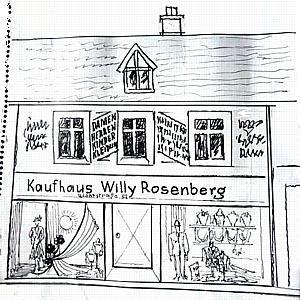
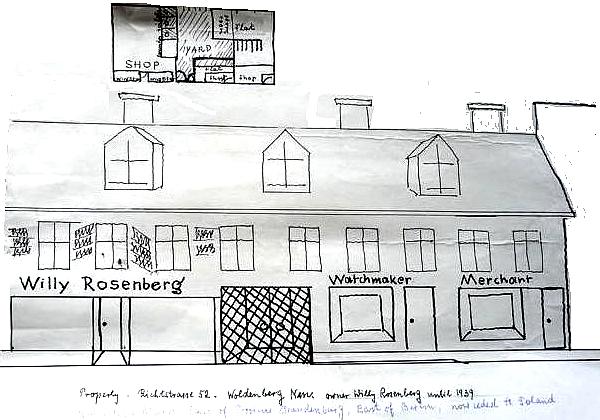
 Konfektionsgeschäft Willy Rosenberg in den 1920er-Jahren. In der Woldenberger
Richtstraße 52 in der Nähe des Pariser Platzes (am hohen Tor). In der
Woldenberger Luftaufnahme ist das
Rosenberg-Haus mit einem roten Punkt markiert.
(Drawing: 1997 – H.-J. Rosenberg)
Konfektionsgeschäft Willy Rosenberg in den 1920er-Jahren. In der Woldenberger
Richtstraße 52 in der Nähe des Pariser Platzes (am hohen Tor). In der
Woldenberger Luftaufnahme ist das
Rosenberg-Haus mit einem roten Punkt markiert.
(Drawing: 1997 – H.-J. Rosenberg)
|
|
Moving to Richtstrasse 52
My parents had rented business premises and living quarters from a family Fiedler who lived in the
same house and ran an ironmonger
business. One of my earliest recollections was a pig being slaughtered for the Fiedler’s. I can
still remember the terrible screams of that poor animal. It made a deep impression on me and soon after
we moved to larger premises at Richtstrasse 52, a building comprising my parents large shop and four
bedroom flat and two other shops with living accommodation.
There also were a number of cellar rooms under the house for storage of fruit, vegetables etc. Behind the
house was a large garden. Though it contained some roses it was mainly used for vegetables and fruit
trees. An enclosure contained a number of chickens and a beautiful cockerel whose awakening crows gave us
– and probably our neighbours – an early start. Under the roof was an extensive loft with a
couple of rooms for living in employees and a vast area for us kids to roam about.
Otherwise, conditions were rather primitive. Toilets were outside in the yard and water had to be carried
from a pump in buckets by our maid for drinking, cleaning and all purposes. Last but not least I must
mention Rolf, our German shepherd dog. A kennel filled with straw was provided for him in the yard but at
night he stayed in the shop to deter would be burglars. He was running next to my bike on my ride to go
fishing or go roaming through the forests and chasing rabbits and hares that lived there in abundance.
Luckily he never caught any.
I am sorry to say that all the compensation the German Government gave me for the loss of this lovely
property, was 3000 Mark [DM = approx. 1500 Euro].
Kinderfräulein Dänhardt
I must mention here Fräulein Else Dänhardt, our Governess, a strict disciplinarian, who
before coming to our home had cared for the offspring of an aristocratic Prussian family. She never let
us forget that she possessed a diploma of education and her sense of humour was comparable to that of an
empty book.
Now late in life I think that I should be grateful to my parents, but I was not. I hated that
person who beat my sister and me mercilessly when she caught us at a misdemeanour, and many times I
pulled faces behind her back or broke out in uncontrollable laughter with my sister Eva when told by her
to keep a straight face.
I once put a live eel wrapped into a napkin into her bed and I remember her screams that a snake was in
her bed. When told about my malice my dad could hardly keep a straight face. To get rid of her I asked
Mr. Schauseil my teacher at school
who was a renowned bachelor if he would like to marry her. With a straight face he declined.
My Father
My dad [Willy Rosenberg] was a kind man who loved a good joke, good food and good company. I cannot
remember him ever beating me or being unkind to us. He supported any public or private cause he thought
deserving, and I never heard a bad word spoken about him. He was a true republican, anti-imperialist, an
elected town councillor of the Democratic party, a committee member of the
‘Schützengilde’ (a target shooting true German organization), which paraded with great
pomp in green uniforms with the ‘Stadtkapelle’ (the towns band) leading the march through the
town to target shooting.
There a lunch was served consisting of ‘Wiener Würstchen’ (Frankfurters) and at night
time the man who shot best was paraded as ‘Schützenkönig’ (king of the marksmen)
through the town. This “King” then had the honour to pay for the drinks for all members of
the guild. And how they could drink. I think that my dad aimed slightly off the target for that occasion
to escape the honour and expense of being the King. Although sometimes he brought home some valuable
prizes.
The Schützenfest
On these occasions I was so proud to carry my dad’s rifle next to the marching column of the
“would be warriors”. ‘Schützenfest’ (festival of the marksmen), though this
is poor translation, was a wonderful occasion. At six in the morning a drummer marched through the
town wakening the population to the great event. A fun fair had established itself with music from
merry-go-rounds, shooting galleries, prize winning booths, foods, ice-cream vendors etc. etc., it was a
paradise for a young impressionable mind.
Father’s Best Friend
At night time the march back of the “warriors” slightly unsteady on their feet to rousing
speeches by the mayor, fireworks and the ‘Zapfenstreich’ (the sounding of the retreat). Among
these ‘Schützen’ was the honoured figure of the First Knight the highest distinction
next to the King, he was my dad’s best friend, Georg Rubenson, another member of the small
but prosperous Jewish community. He was a man about town, a corn merchant, whose philandering and living
above his income eventually led him to ruin.
He was a most likable blustering personality, a devil to the women. His wife was a fine, educated and
very artistic lady, an accomplished piano player who had deserved better and who suffered in silence.
They had to give up their home to live in Königsberg in East Prussia as was its name at that time.
They spent the last night in my parent’s home and I remember that during this night the bailiff
arrived to impound their silver Cutlery and other items.
After the war [WW II] “Adi Leue” [Adolf Leue] told me that when the
Gestapo came
during the war to collect and transport him, Georg Rubenson shot himself. He was a man who was decorated
with the Iron Cross First Class in World War I for personal bravery — incidentally the only
decoration Adolf Hitler ever was
awarded! Strangely their end was similar.
Father liked Beer, Skat, and Soccer
To return to my dad who was engaged in many more activities like the angler’s club, local sports,
he was president of the Chamber of Commerce and president of the local Jewish community. To this small
Jewish community I shall return a little later.
The only time I ever saw my father excited and angry, except after he heard my experiences in K.Z.
Sonnenburg, was when he played ‘Skat’, a German card game. He was an excellent player and he
became very angry if people did not come up to his standard. On Sunday afternoons if he did not go to
watch the local soccer, he went to the “Hotel König von Preussen” to play Skat with some of his friends.
The Leues went to the U.S.A.
| |
|
|
|
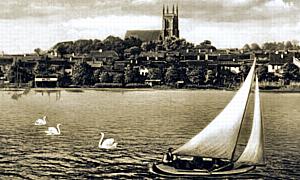
Woldenbergs Großer See. Es ist kein Angler- Latein. Hier konnte man tatsächlich einen
solchen 20-pfündigen Karpfen (10 kg) fangen.
(Repro: 2009 – khd)
|
|
On some evenings he played with his friends that included Adolf
Leue. Adi was a true Christian
believer who had fallen in love and married a Jewess Luzie. He owned a well-to-do
‘Delikatessen’ business [at Richtstrasse 45] with a pub-bar attached to it and on Sunday
morning’s dad took me sometimes there to eat Frankfurters and have his beer. The place used to be
crowded with people having a Sunday morning drink.
My dad loved to mix with the locals. It was also prudent for business. One should understand that Sunday
in Germany was a day for amusements, drinks etc. quite different to the English way of subdued
contemplation. Adi’s father who loved to go out fishing in a rowing boat on the
Woldenberg lake, once took me along and he landed a 20 pound carp,
he said: “With my useful assistance.” Well the Leues sent us a portion of the fish to show
their gratitude. I must have been about 10 years of age (approx. 1927).
After the war I saw Adi and Lucie again in San Francisco. Both had survived the war. They had build up a
new life in the U.S.A. Lucie was suffering from some sort of dementia, no wonder after the horrible
events in Nazi Germany. He treated her like an angel, cooked, cleaned and looked after her. He related to
us the events in Berlin of my parents and sister. After leasing their house and business to a chap called
Schluter, they retired to Berlin.
Taken to Auschwitz
In 1942 my mother was taken in her working clothes to be sent to
Auschwitz death camp. My
dad who was not present at the time volunteered to go with her and had to beg for permission. My sister
Eva who had married and was expecting followed a little later.
Adi Leue told me in San Francisco that he tried to help with food. When he as a gentile was conscripted
into the German Army as a Quartermaster he sent left over food to my parents. He was a truly righteous
“Gentile”. After the death of his beloved Luzie he returned to Berlin where Regina and I
visited him in a most comfortable retirement home where he died a few years ago.
Jewish Life in Woldenberg
Let us return now into the 1920’s to Woldenberg my birth place: I cannot say anything about the
Catholics, they played no great part in the community as far as I know. A different story with the Jews.
There was only one Jewish academic – a brilliant lawyer Hanns Weinberg who will feature later
in my story.
Most of the clothing and shoe shops were Jewish, there was an ironmonger named Kiwi whose nephew
Henry (Heinz) Steinberg from Stettin lives in London, a good friend. The corn merchant G.
Rubenson before mentioned and a number of horse and cattle
dealers whose excited shouting and clapping of hands could be heard when they were dealing with the
farmers.
The Jews played an important part between the country and town population. There was a division of
language between town and country. The country folk spoke ‘Plattdeutsch’ – a low German
dialect akin to the old type of German. To gain their confidence in business one had to be able to
converse in that idiom. Socially there was little contact between gentiles and Jews.
Only Adi Leue was considered half a Jew and a music teacher kept social contact with us; amongst the Jews
the divisions were money and education. I never felt that there was a division of sorts between the
gentile boys and myself. I did not care for organised religion and I felt certainly racially not inferior
or different to them.
| |
|
|
|
Woldenbergs Synagoge war in dieser Junkerstraße Nr. 9 (Haus mit den Türmchen). Sie wurde 1858 eingeweiht,
als in Woldenberg noch um die 120 Juden wohnten. In den 1920er-Jahren lebten in Woldenberg nur noch um die
60 jüdische Bürger.
(Repro: 2009 – khd)
|
|
I remember feeling rather uneasy when dad dressed in a black coat and top hat walked me to the synagogue
at the time of High Holidays. The synagogue was built for a larger congregation than existed at that
time. Jews had left the countryside for the more exciting life in the large cities.
The Cantor
Officiating was Cantor Piankowski [Ed: in the Woldenberg address directory of 1924 his name is Isidor Pionkowski], an
orthodox Jew whom I have to thank for my limited knowledge of Judaism. He was a kind old man whose
emotional way of preaching found far more approval with the gentiles, who flocked to Jewish funerals to
hear him than his Jews. Grey beard, Semitic, features, kind wise eyes, he looked as the essence of
Judaism.
Schools in Woldenberg
There existed two schools in Woldenberg.
One was the ‘Volksschule’ or primary which everyone had to go to for four years before going
to higher education and there was the ‘Mittelschule’ for secondary higher education.
[List of Woldenberg’s teachers]
At primary school I met Heinz Brunness. We became inseparable friends. He was the son of a senior
railway and station master [‘Oberbahnmeister’] at our local railway. He was a nice boy,
intelligent and tough. Thanks to the efforts of our Governess “Fräulein Dänhardt”,
I was seated No. 2 in our class. Numbers were allocated by merit, Heinz was No. 4. No. 3 was the son of
our local social democratic leader Beyer who unfortunately did not go on to higher education,
though he deserved it.
Heinz Brunness was stronger than me and we fought many a battle. He could not stand me sniggering
when caught with a lack of knowledge at school. But being both of middle class background we fought
battles against all types of imaginary enemies should it be Romans, Poles or French. When he slept one
night in the same room with me, he confessed that he did not believe one word about religion he was
taught. We both had a great time together.
The hated Hakenkreuz
I also was friendly with a boy of my age Werner Schulz whose father [Emil Schulz] was the assistant headmaster at the middle school. When I played
with him at his home and we entered his father's study I discovered a small pin-up disc of a Swastika
[‘Hakenkreuz’] to be worn in the lapel. Werner looked rather sad and embarrassed at my
discovery and he tried to laugh it away.
But I could not forget this incident: To think that a senior schoolmaster whose son was on friendly terms
with me should wear that hated sign. Years later I saw the father marching in the brown uniform of
Hitler’s S.A.
I have to mention Herrn Schauseil our teacher at primary school. Some boys called him
‘Scheusal’ (a monster) but only those who got the birch or some of the best (the cane). He
was a former army officer who carried himself upright with a military bearing. My dad used to joke that
he walked about as if he had swallowed a walking stick. Yet he was a kind person — my dad said:
|
| |
|
|
|
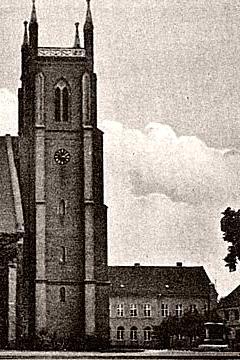
Woldenbergs Kirchturm der Marien- Kirche am Marktplatz. Dahinter ist ein Teil des Schulhauses zu
sehen.
(Repro: 2009 – khd)
|
|
“A social democrat.” He was responsible for me skipping fourth year at primary to go to
secondary education. I feel that our Governess “Fräulein Dähnhardt” had to get some
credit; who curtailed my angling, fighting and similar activities to make me sweat at home.
Girls were better than boys
The secondary or ‘Mittelschule’ was a mixed school. There were girls, though we sat
separately, boys on one side and girls the other. The girls at least at that early age were
intellectually superior. They occupied the top five positions in class. The No. 1 position was held by a
lovely bright girl Lenchen Fuss who came home with us to my parents before being collected by
horse and buggy to the village where her father was a prosperous farmer.
My pronunciation was considered excellent and at school festivals I was required to recite poetry to the
assembly of parents and teachers. Herr Richmer, the math teacher had taken an instant dislike to
me and he let me feelt at every opportunity. My parents once asked him to come to our home to find out
the reason for his dislike. He slowed down a little but not much.
Beside Heinz Brunness and to a lesser extent Werner Schulz I had little contact with other
boys of my age except at school.
The Political Situation
The political situation in Woldenberg was divided. The Protestant bourgeois middle class was strictly
conservative – ‘deutsch-national’. They showed at election time their allegiance by
displaying large black white and red flags from their windows, occasionally interrupted by a black, red
and gold flag where a Jewish family lived. These conservative people were pinning back to the grand days
of the ‘Kaiser’ and German greatness.
Outside the business centre and the suburbs in the so-called working class district the colours black,
red and gold were displayed – the colours of the
“Weimar Republic”
with the occasional interruption of a red flag. The majority of these people voted for the “Social
Democrats” [Ed: today called the SPD] a left leaning truly democratic with socialist ideals party
that had given to Germany with the assistance of the catholic centre party and the liberal democrats (my
dad’s party) one of the freest and finest constitutions in the world
[“Weimarer Verfassung”].
Unfortunately the German people were not ready for it. To protect the Weimar Republic, the 3 democratic
centre ties founded a type of militia, the
‘Reichsbanner’ black-red-gold mainly supported by
the Social Democrats but my dad a member and I joined at a later stage. The conservatives had formed the
‘Stahlhelm’ (the steel helmet). They wore field grey uniforms and were led by
former army officers [from the World War I].
Brown Shadows over Woldenberg
Though these two militias sometimes clashed, it was somehow a gentleman’s agreement to keep out of
each others hair. The Communists formed the Red Front fighters, and then – most sinister – Hitler,
Göring and Himmler formed the S.A. and S.S. units of the National Socialists party
[NSDAP], whose brawling strong arm methods soon started to dispute the streets [Ed:
also auch in Woldenberg].
I remember well the grand district meeting of the ‘Reichsbanner’ when black red and gold
garlands with slogans like: “Never again war” stretched across the streets. Pacifism ruled
but soon the hated swastika appeared dangling from many a window. Soon its shadow was to fall right
across Europe.
| |
|
|
|
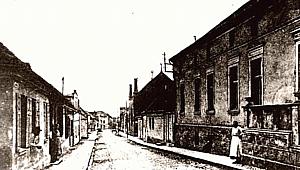
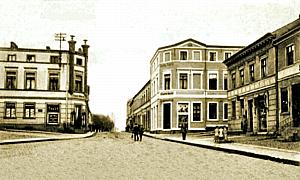
Pariser Platz mit Richtstraße in Richtung Kastanienplatz. Auf der rechten Seite dieses
Abschnitts der Richtstraße lag das Konfektionsgeschäft von Willy Rosenberg – das Haus, in
dem H.-J. Rosenberg aufwuchs. Und schräg gegenüber wohnte Vaters bester Freund Georg Rubenson, der Getreidehändler. In der
Woldenberger Luftaufnahme ist das
Rosenberg-Haus mit einem roten Punkt markiert.
(Repro: 2009 – khd) |
|
At election time large heavy encrusted swastikas were painted on the shop windows of all Jewish shops
during the night before a general election. In the morning one could see the maids or shop assistants
scrubbing hard to remove these abominations. There must have been disquiet among some Jews but on the
whole this act of vandalism was considered a childish prank. Well, sinister forces had started to
stir.
Living in Peaceful Coexistence
Woldenberg was a small town of ca. 5000 inhabitants; there were some small industries as far as I can
remember like a brickyard, a brewery, a soap factory and a very active shopping centre that did not rely
only on the support of the townspeople but also was supported by the farmers and farm workers who flooded
on Saturdays into the town to buy their necessities but also to sell their agricultural produce like
home baked bread, eggs, butter and birds. I still remember the aroma and taste of
‘Bauernbrot’, the bread of the farmers.
The town boasted two policemen. Woldenberg was a law-abiding place, its citizen living in peaceful
coexistence. The only alert came when Gypsies arrived in town and even my sister and I was alerted by my
parents to watch the merchandise. These Roman people held a special fascination for me, they dealt in
horses, read your palms and had a poor reputation for honesty. I did not know how true this was.
Circus, Forests and Lakes
I loved to go to fun fairs and the circus that arrived at regular intervals. The clowns, the jongleurs,
the trapeze artists! I remember a little girl dressed and beautiful like a fairy queen performing with an
umbrella on a tight rope. The following day she shopped with her mother in our store. I was so
overwhelmed by being confronted by so much beauty that I could not utter a word.
Woldenberg was [Ed: and it is still] surrounded by lakes and forests and a small river named the
“Fliess” running into a
large lake – wonderful fishing and bathing in the public bath at the lake. The woods contained deer,
hares and boars. These boars or ‘Wildschweine’ were quite dangerous and we were instructed at
school how to behave if confronted by one. The idea was that though these animals were quite fast and
powerful, one should change directions by jumping and hiding behind trees. Thankfully I never confronted
one of these beasts.
The Churches
The majority of Woldenbergers were Protestant. There was a small Catholic minority with a small church
and an even smaller Jewish community with their own temple and
a cantor (singer) who gave us few Jewish children lessons in Hebrew
and religious instructions.
The Protestant church was large and beautiful and boasted a tower
that looked rather unfinished. Instead of a tall steeple four small turrets were built at each top corner
of the tower looking like bottles on top of the church. The unconfirmed story goes: When Frederic the
Great came to Woldenberg he found the citizens drinking beer instead of welcoming him. So he had four
beer bottles built on top of the church.
[Another story of the tower]
Leaving for Stettin
When I was nearly 13 years of age, my parents decided to send me to grammar school in Stettin, a fairly
large harbour city on the Baltic Sea [some old Stettin pictures]. They must have had in mind that I could study at a university a
profession and that my sister would inherit the business and marry well.
Anmerkungen / Remarks of the Editor:
[Translation-Service]
1) 
Die hier dokumentierten Erinnerungen sind Teil einer bislang unveröffentlichten Autobiographie des
1915 in Woldenberg/Neumark geborenen jüdischen Autors, die dieser zwischen 1990 und 1992 aufschrieb.
Sie fanden – anläßlich eines
Gästebucheintrags – eher zufällig ihren Weg von Tasmanien, wo sein Sohn
Randolph heute lebt, via Berlin nach Toronto ins Internet. Ohne das Internet hätten wir nie vom
Schicksal dieser Rosenbergs erfahren. Randolph Rose(nberg) schrieb Anfang September 2009: „I’m
sure my dad would be proud to know it is on the web.“
2)
Hans-Joachim Rosenberg ist der Sohn von Willy Rosenberg, der in Woldenberg ein feines
Konfektionsgeschäft in der Richtstraße 52 betrieb. Willy Rosenberg, dessen Ehefrau Ella sowie
Eva, die Schwester von Hans-Joachim Rosenberg wurden alle von den Nazis in
Auschwitz ermordet.
Hans-Joachim Rosenberg gelang im Frühjahr 1939 mit seiner Ehefrau gerade noch die Flucht über
Belgien nach England, wo er genau an seinem 24. Geburtstag eintraf. Nach dem
Kriegsausbruch am 1. September 1939 trat
er der britischen Armee bei und kämpfte mit den Engländern gegen Nazi-Deutschland – eine
durchaus merkwürdige Situation für ihn, hatten doch sein Vater Willy und sein Onkel im
1. Weltkrieg (WW I) das
Eiserne Kreuz vom Deutschen Kaiser erhalten. Nach dem
2. Weltkrieg (WW II)
wanderten sie nach Australien aus.
3)
Im
Woldenberger Adressbuch von 1924 sind die
folgenden Viehhändler (cattle dealers) verzeichnet:
BEHLKE, FALBE, FRITZ, GURKASCH, HOMUTH, JAKOB, KROLL, MUSKE, RAU, RITT, WERNER.
Derzeit ist nicht bekannt, welche Familien davon zur jüdischen Gemeinde gehörten.
4)
Some of those links point to Wikipedia articles in German. Those who like them in English should look
at the left side of the Wikipedia pages. There you‘ll find a link to the English version.
5)
Other Rosenberg’s: Im Internet wurden auch andere (Willy) Rosenberg
gefunden: Ein
Willy Rosenberg aus Ziegenhain fiel im 1. Weltkrieg am 5. März 1915.
Eine Familie
Willy Rosenberg lebte in Ratzeburg, wo auch sie ein kleines Kaufhaus betrieben.
In London lebte ein
Poet und Maler Isaac Rosenberg (1890–1918), dessen Familie aus Litauen
stammte. In den USA lebt heute eine
Maddy Rosenberg, die eine Multi-Künstlerin ist.
Ob diese und andere Rosenbergs mit den Rosenbergs in Woldenberg verwandt sind, ist möglich, aber
nicht bekannt.
6)
Some important references:
7)
Dieser Konrektor Emil Schulz war 1933 in Woldenberg der Ortsgruppenleiter der
NSDAP (Nazi-Partei). Das geht aus einem Bericht der „Woldenberger Zeitung“
vom 14.6.1933 hervor.


 Diese Seite ist Teil eines
Woldenberg-Reports. Woldenberg – heute das
polnische Dobiegniew – war bis 1945 eine
kleine Stadt in der Neumark (Nm), dem damals östlichsten Teil der Mark Brandenburg. Zwar wurde zum
1. Oktober 1938 der Landkreis Friedeberg/Nm mit Woldenberg der Provinz Pommern (Pm) zugeschlagen,
dennoch fühlten sich die Einwohner weiterhin als Neumärker. Seit 1945 gehört
Woldenberg/Pm zu Polen.
[Geschichte Woldenbergs]
Diese Seite ist Teil eines
Woldenberg-Reports. Woldenberg – heute das
polnische Dobiegniew – war bis 1945 eine
kleine Stadt in der Neumark (Nm), dem damals östlichsten Teil der Mark Brandenburg. Zwar wurde zum
1. Oktober 1938 der Landkreis Friedeberg/Nm mit Woldenberg der Provinz Pommern (Pm) zugeschlagen,
dennoch fühlten sich die Einwohner weiterhin als Neumärker. Seit 1945 gehört
Woldenberg/Pm zu Polen.
[Geschichte Woldenbergs] Darin wird erstmals etwas über das jüdische Leben in Woldenberg sowie über den Beginn der
Nazizeit berichtet. In dem im Original belassenen Text wurden einige Anmerkungen [Ed: ...], die
Zwischentitel, Links und einige Fotos sowie ausführliche
Bildlegenden redaktionell hinzugefügt. Auch werden hier alle Woldenberger Namen fett gedruckt.
[Translation-Service]
Darin wird erstmals etwas über das jüdische Leben in Woldenberg sowie über den Beginn der
Nazizeit berichtet. In dem im Original belassenen Text wurden einige Anmerkungen [Ed: ...], die
Zwischentitel, Links und einige Fotos sowie ausführliche
Bildlegenden redaktionell hinzugefügt. Auch werden hier alle Woldenberger Namen fett gedruckt.
[Translation-Service]


 © 2009–2012
Karl-Heinz Dittberner
(khd) – Berlin
—
Homepage
—
Last Update: 10.12.2013 13.48 Uhr
© 2009–2012
Karl-Heinz Dittberner
(khd) – Berlin
—
Homepage
—
Last Update: 10.12.2013 13.48 Uhr